Houses, units, equity and rent
Investment Loans Coffs Harbour
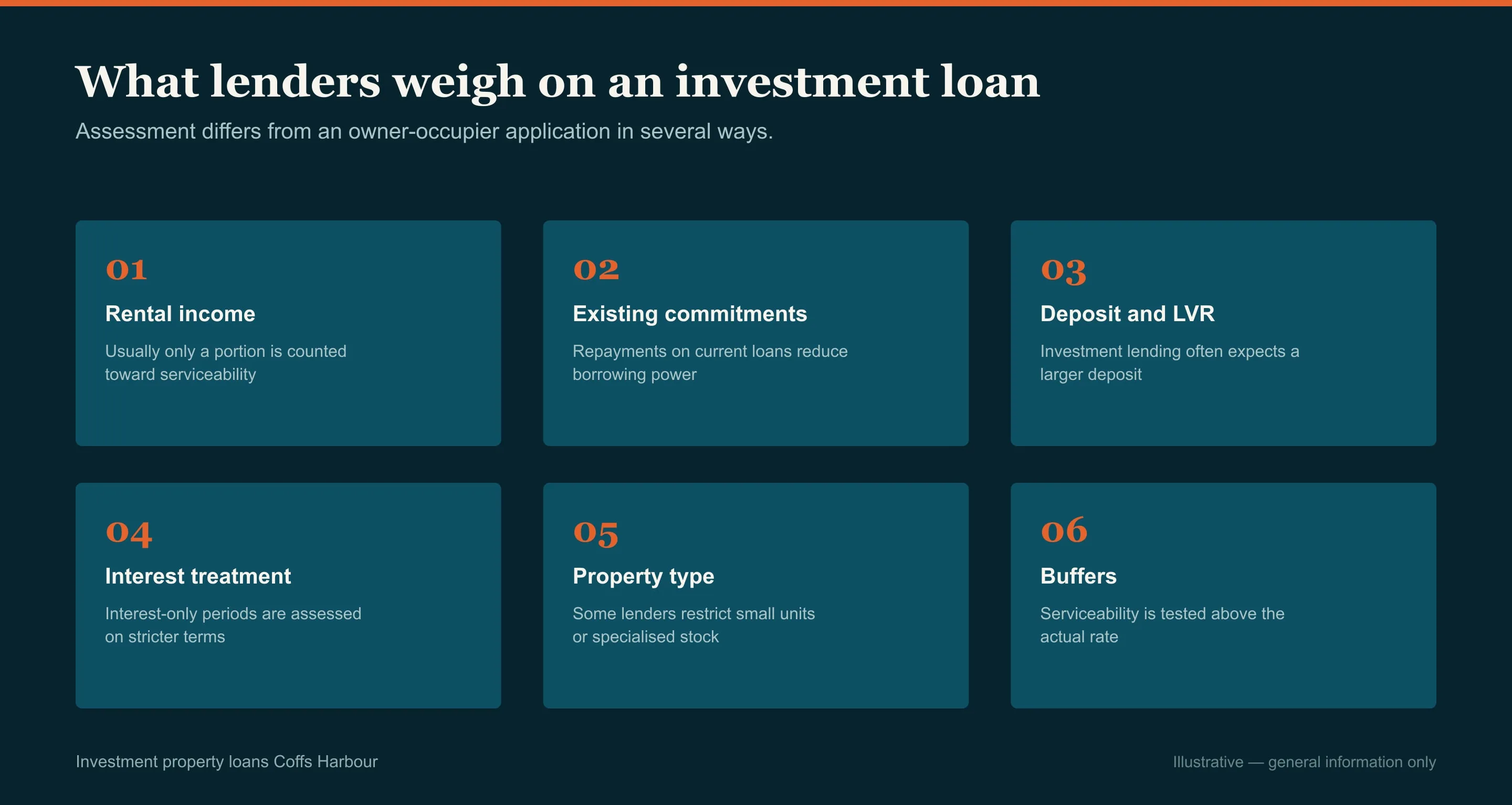
A lender counts about 80% of the rent, not the rent. That single haircut decides more investment loans Coffs Harbour buyers apply for than the yield on the property ever does.
We work out what a lender will actually count from a property before you commit to it: the shaded rent, the deposit or equity behind it, and whether the debt to income test leaves room for the next one.
- The rent figure a lender will use, not the agent estimate
- Houses and units priced against each other
- Your existing portfolio counted before you buy
Price up an investment purchase
Tell us the property you are looking at, or just the budget you have in mind.
What We Work Out Before You Buy
We take the property you are considering, apply the rent shading the lender will apply, add it to your income, and test the whole position against that lender’s policy. Then we do it again across the lenders whose rules suit you. What comes back is a borrowing figure for that property, plus the deposit or equity it needs and the structure that keeps your next purchase possible.
It suits you if you are buying your first investment property in Coffs Harbour, adding to a portfolio, or rentvesting: renting where you want to live and owning where the numbers work. It also suits you if you already own here and want to know what your equity would fund.
Asking costs you nothing. The lender pays us a commission when a loan settles, so the assessment, the comparison and the application are all free to you, and that holds even where we tell you the property does not stack up.
Step by step
How We Set Up An Investment Loan
Five stages. The order matters, because the structure decisions get much more expensive to unwind once the loan is written.
-
Your goal and your ceiling
We start with what you are trying to build, then work out what you can borrow against your income before any rent is counted. That is your floor.
-
Deposit or equity
We work out whether you are using cash, equity from a property you already own, or both, and what each option does to your loan to value ratio.
-
Structure
Interest only or principal and interest, which loan sits against which property, and whether the loans are kept separate. You get told what each choice costs and what it makes possible later.
-
Lender match
Rent shading, existing exposure and debt to income treatment differ sharply between lenders. We lodge with the one whose policy reads your position best.
-
Valuation and settlement
We chase the valuation, answer the lender’s questions and coordinate with your conveyancer, so you find out about a problem while it can still be fixed.
What to have ready
- Two recent payslips each, or two years of tax returns if you work for yourself
- Statements for any loans, cards and existing investment properties
- A rental appraisal or the listing for the property you are looking at
- Your latest rates and insurance notices for anything you already own
First questions
Questions Before You Buy
What does it cost me to use you?
Nothing. The lender pays us a commission when your loan settles, and it is set by the lender rather than varying with which one we recommend. Running the numbers on a property that turns out not to work costs you nothing either, and we would rather do that than watch you buy it.
What do you need from me to get started?
Your income, your existing loans and cards, and either a property or a budget. If you already own, add the latest statement and rates notice for each property. That is enough for a borrowing figure you can rely on.
Can you help if I already own several properties?
Yes, and that is where lender choice matters most. Lenders differ on how much existing exposure they will tolerate, how they treat the debt on properties held with other banks, and where their debt to income ceiling sits. We map your whole position first, then lodge with the one that fits it.
What You Are Buying Into in Coffs Harbour
Two numbers make the local case, and they pull in the same direction. Vacancy across Coffs Harbour sat at 1.1% in the PRD Market Update for March 2026, well under the 3.0% the REIA treats as a balanced market. Yields have been running above Sydney: the same PRD update put houses here at 3.4% against 2.8% for Sydney metro.
A second source reads higher. CoreLogic figures published through Your Investment Property in February 2026 put Coffs Harbour houses at 4.44% and units at 4.93%. The two diverge because they measure over different windows and different property sets, so we quote both with their dates rather than picking the flattering one and calling it the yield.
What that means for your application
Low vacancy supports the rental assumption in your file, which helps. It does not change the shading, and no lender lifts its rent factor because a market is tight. So we treat the vacancy figure as evidence the rent is achievable, and we run your numbers on the shaded figure regardless.
Selling time is worth knowing before you buy rather than after. CoreLogic had Coffs Harbour houses taking around 42 days to sell in February 2026 and units around 46. That is the exit, and lenders care about it on acreage and unusual stock more than on a standard house.
What Coffs Harbour Rental Income The Bank Will Count
Not all of it, and how much depends on what kind of letting you are proposing. The lender discounts the rent to cover vacancy, management, rates and repairs, and the discount is heavier the less reliable the income looks.
- A standard long-term lease: usually around 80% of the rent counted
- Holiday or short-term letting: commonly 70% to 80%, and some lenders decline it
- Serviced apartments: as low as 60%, with a much shorter list of lenders
Holiday letting on the coast
A short-term let can gross more than a lease and still borrow less, because the lender counts a smaller share of a figure it treats as seasonal. On the Coffs Harbour coast that trade is a real one, so we run both scenarios before you buy and show you what each does to your borrowing power.
Where you plan to holiday let, we also check the lender accepts it at all and what evidence it wants: a letting appraisal, a management agreement, or the previous owner’s income history. We sort that before lodgement, not after a valuer notices the property is on a booking site.
The debt to income cap
From February 2026 lenders can write no more than 20% of new mortgages at six times income or above. Investors hit that ceiling first, because shaded rent lifts your debt faster than it lifts your assessable income. If you are near six times, which lender you approach matters more than the rate, and we choose on that basis.
Share of local rentals sitting empty
1.1% vacancy
Well under the 3.0% the REIA treats as a balanced market. It supports the rental assumptions in an application, though the lender still shades the rent before counting it.
PRD Coffs Harbour Market Update, March 2026
How You Fund The Deposit: Equity Or Cash
If you already own in Coffs Harbour, the deposit may already exist. We work out how much of your equity is usable, which is the value below 80% of the property less what you still owe, and release it as a separate loan against your existing home.
Keeping it separate matters more than most investors are told. A split loan keeps the investment borrowing identifiable, which is what your accountant needs at tax time. Mixing it into your home loan is easy to do and awkward to unpick later.
Equity, or cash
Equity preserves your savings and usually costs less than the alternatives, but it raises the debt on the Coffs Harbour home you live in, and it ties the two properties together if a lender cross-secures them. We avoid cross-securitisation where we can, because it makes selling one property later a negotiation with the bank.
Cash keeps the two properties independent and your existing Coffs Harbour loan untouched. It also spends the buffer you might want if a tenant leaves. We put both on the table with the numbers attached, rather than assuming which one you would prefer.
Should You Buy A House Or A Unit?
On the CoreLogic figures above, units were yielding more than houses here in February 2026. Lenders still treat them differently, and the differences show up in what you can borrow rather than in the rate.
Size is the first test. A Coffs Harbour unit under about 50 square metres of internal living area gets a reduced loan to value ratio from many lenders and is declined outright by some, whatever the rent. Building size matters too, because a large complex can hit an exposure limit where a lender already holds too many loans in it.
What we check before you offer
- Internal area, and whether it clears the lender’s minimum
- How many loans that lender already holds in the same building
- Strata levies, which come out of the rent before it reaches you
- Whether the valuation is likely to support the contract price
Houses avoid most of that and carry land, which is what tends to move in value around Coffs Harbour. They also cost more to hold. Which one suits you turns on how much vacancy your cash flow can absorb, so it is worth settling before you are standing at an auction.
Asked and answered
Investment Loan Questions
How much rent will the bank actually count?
Usually around 80% of a long-term lease, roughly 70% to 80% of holiday or short-term letting, and as little as 60% on a serviced apartment. The shading covers vacancy, management and maintenance. It varies by lender, which is why the same property can support different loan sizes at different banks.
Can I use the equity in my home to buy an investment property?
Usually yes. The usable portion is the value up to 80% less your current balance, and we release it as a separate split so the investment borrowing stays identifiable for tax. Going above 80% is possible but triggers mortgage insurance on the released amount.
Are yields in Coffs Harbour better than Sydney?
On the figures we have, yes. PRD’s March 2026 Market Update put Coffs Harbour houses at 3.4% against 2.8% for Sydney metro. CoreLogic figures published through Your Investment Property in February 2026 read higher again at 4.44% for houses and 4.93% for units. The two use different methods and windows, so treat them as a range rather than one number.
Does the debt to income cap stop me from investing?
It restricts how much lending each bank may write at six times income or above, rather than banning it. Investors reach that level sooner because shaded rent adds less income than the loan adds debt. If you are close to it, we find the lender with room and structure the application to sit under the threshold where we can.
What happens if the property is empty for a while?
You cover the repayments in the meantime, which is why lenders shade the rent in the first place. We test your position with a vacancy in it before you buy, so the answer is a number you have already seen rather than a surprise.
Who you deal with
Who Runs The Numbers
The person who answers is the one who applies the shading, tests the lenders and tells you whether a property services. You are not passed to a processing centre once the application is in.
Knowing which lender counts holiday letting, and at what factor, is local knowledge on this coast rather than a general policy question. We are in Coffs Harbour and deal with those lenders regularly.
- What it costs to ask
- Nothing. We are paid a commission by the lender when a loan settles, not by you.
Where to start
Find Out What A Property Will Actually Borrow
Send through a listing or a budget and we will tell you what a lender counts, what deposit or equity it needs, and how it sits against anything you already own in Coffs Harbour.