Acreage, zoning, hinterland blocks
Rural Home Loans Coffs Harbour
Most rural home loans Coffs Harbour buyers arrange fall over on the deposit, not the income. Mortgage insurance is generally unavailable on rural-zoned land, so the 5% deposit path that works in town does not exist out there at all.
We check the size, the zoning and the use of the specific block before you go unconditional, then find the lender that will actually write it and tell you what deposit it needs.
- The block assessed before you go unconditional
- Lenders matched to size, zoning and use
- A real deposit figure, not the in-town one
Have a block checked
The address or the listing is enough. Size and zoning are what we look at first.
What We Check On Your Block
We look at the land size, the zoning, what the property is used for and how readily it would sell, then work out which lenders will lend on it and at what loan to value ratio. That produces a deposit figure for that specific block. We then package the application, manage the valuation and see it through to settlement.
It suits you if you are buying acreage or a lifestyle block in the hinterland behind Coffs Harbour, refinancing one you already own, or you have been told by a bank that the property is outside policy without being told why.
The check costs you nothing, and it is worth doing before you sign rather than after. We are paid a commission by the lender when a loan settles, so telling you a block will not finance on your deposit is advice we give for free and would rather give early.
Step by step
How We Finance An Acreage Purchase
Four stages, and the first one decides most of it. On rural property around Coffs Harbour the block sets the terms at least as much as the borrower does.
-
Property and zoning check
We pull the size, the zone and the permitted use, and work out which lending category the property falls into. This is the step that tells you what deposit you are really going to need.
-
Lender match
Appetite for acreage varies enormously, and some lenders are cautious about particular areas regardless of how strong you are. We go to the ones with real appetite rather than testing your file against a decline.
-
Valuation
Rural valuations take longer and come back with more conditions than a house in Coffs Harbour itself. We brief the valuer properly and allow for the extra time in your finance clause so the contract date is not the thing that fails.
-
Settlement
We handle the lender conditions, which on acreage often include access, water and services questions, and coordinate settlement with your conveyancer.
What to have ready
- The listing or the address, and the land size in hectares
- The zoning, which is on the contract or the planning certificate
- What the land is currently used for, including any commercial crop
- Details of access, water supply and power to the block
- Two recent payslips each, or two years of returns if you work for yourself
First questions
Questions Before You Sign
What do you need from me to check a block?
The listing or the address, the land size and the zoning. Those three tell us which lending category it falls into and roughly what deposit it needs. Your income details come after, once we know the property will finance at all.
Do you charge me for checking a property?
No. The lender pays us a commission when a loan settles. Checking a block and telling you it will not work on your deposit earns us nothing, and it is still the most useful thing we do on this kind of purchase.
How long does approval take on acreage?
Longer than for a house in Coffs Harbour itself. Allow one to two weeks to a conditional answer and then extra time for the valuation, which is harder to arrange and comes back with more conditions. We ask for a longer finance clause in the contract for that reason.
Acreage And Lifestyle Blocks Around Coffs Harbour
The hinterland behind Coffs Harbour is part of the same working market as the coast, and people move between the two constantly. Lenders do not see it that way. Cross from a residential street onto a rural-zoned block and the lending rules change underneath you, even where the drive is twenty minutes.
The deposit trap
This is the one that costs people contracts. Mortgage insurance is generally not available on rural-zoned property, and mortgage insurance is what makes a small deposit work in town. Without it there is no 5% deposit path, and the lender simply caps the loan at what it will write unassisted.
So you can be pre-approved for a house in town, fall for ten hectares, and find the same income supports a far smaller loan. We would rather find that out for you at listing than at finance approval, and on a Coffs Harbour hinterland block it takes about a day to check.
How Land Size And Zoning Affect Your Loan
Size sets the category, and the category sets your maximum loan. These bands are indicative and every lender draws its own lines, but the shape is consistent across the market.
- Under about 2.2 hectares: usually treated as standard residential, up to 90% to 95%
- About 2.2 to 10 hectares: often still residential, with the maximum easing to 80% to 90%
- Over about 10 hectares: commonly specialist lending at around 60% to 70%
- Over about 50 hectares: agribusiness territory, assessed as a rural enterprise
Why zoning matters as much as size
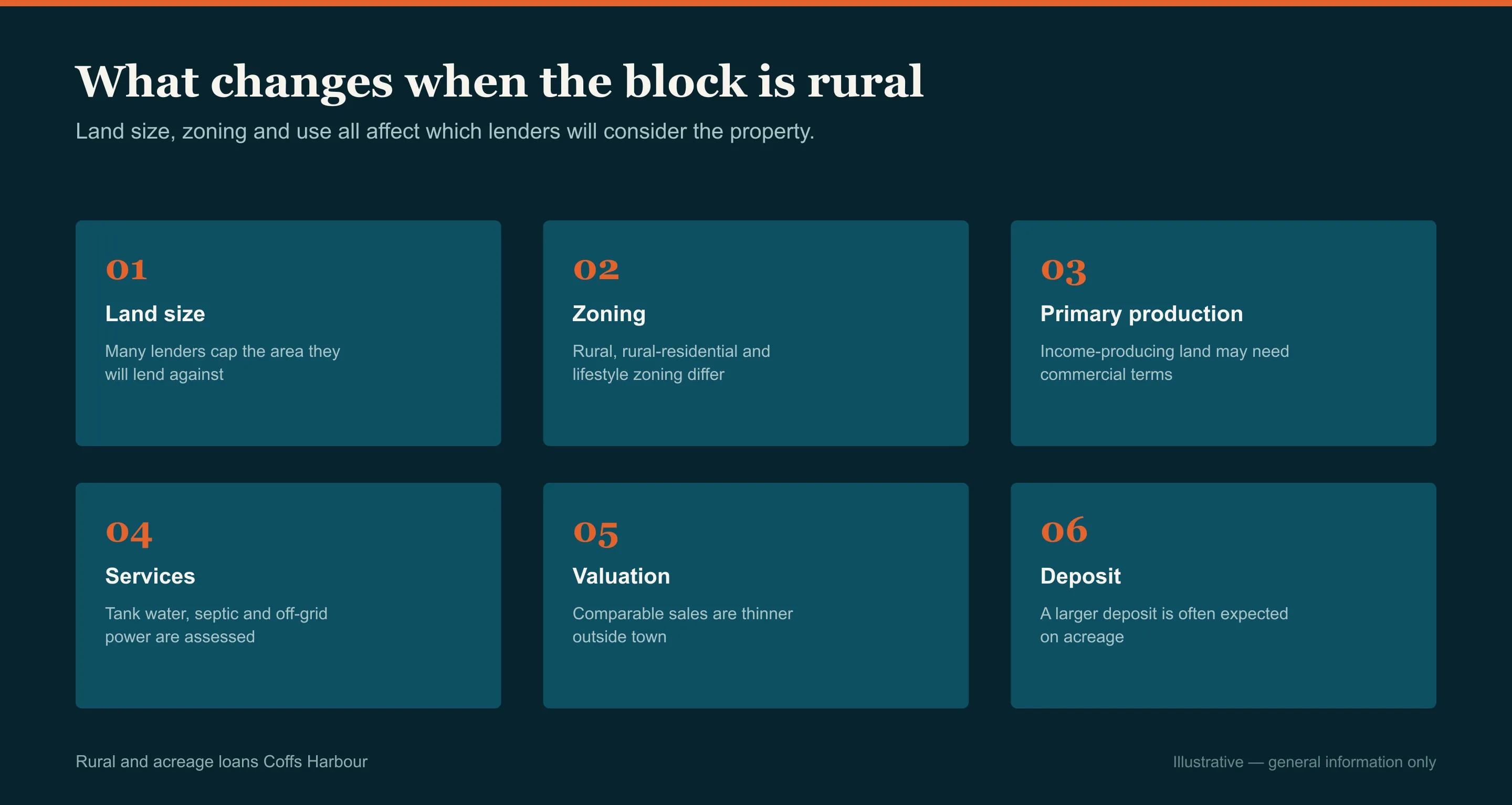
A rural-residential or R5 zoning is read far more comfortably than RU1 or RU2 primary production, even at the same area. The zone tells the lender what the land is for, and primary production zoning suggests a property whose value depends on its productive use rather than on the house.
Marketability sits underneath both. A lender is asking how quickly it could sell the property if it had to, so a low sales volume pocket outside Coffs Harbour can attract a reduced loan to value ratio no matter how strong your position is. That is not a judgement about you, and it is not something a better application overcomes.
Where residential lending usually stops
Around 10 hectares
Past roughly this size most lenders move the file to specialist or agribusiness terms, and the loan-to-value ratio commonly drops to about 60% to 70%. Mortgage insurance is generally unavailable on rural-zoned land.
Lender policy bands, indicative, confirm per lender
When A Property Becomes A Farm Loan
The moment the land earns money, the lending changes. Income-producing horticulture is the common trigger around Coffs Harbour, and bananas and blueberries are the two crops that most often move a block from residential lending into commercial or agribusiness assessment.
What changes when it does
- The loan to value ratio drops, often substantially
- The lender assesses the enterprise as well as your personal income
- Pricing and fee structures move to commercial terms
- The list of lenders shortens to those with an agribusiness arm
A few rows of trees for your own use will not usually do it. An established planting with a commercial history attached, or a lease to a grower, generally will. The line is drawn on the individual property, so we ask what is on the land and what it earns before assuming which side of it you are on.
Lifestyle block, or working holding
If you want the space and not the enterprise, buying a Coffs Harbour block that is already classified as a working holding costs you in deposit and choice of lender for no benefit. Where that is the position, we say so plainly, and often the answer is a different block rather than a different lender.
Financing Hinterland Property Near Coffs Harbour
Hinterland finance turns on the specific block rather than on the district, so the useful answer only comes from looking at yours. Two properties on the same road can sit in different lending categories because one is a hectare larger or zoned differently.
What we look at beyond size and zoning
- Legal access, and whether it runs across someone else’s land
- Water supply, whether it is town, tank or bore
- Power, and what a connection would cost if there is none
- The condition and insurability of the dwelling itself
Each of those can turn into a valuation condition, and a condition discovered after you go unconditional is a problem rather than a detail. We raise them before your finance clause is written.
On timing: allow longer than you would for a house in town. Rural valuations take more time to arrange and come back with more questions, so we ask for a longer finance clause up front rather than requesting an extension later.
Asked and answered
Rural And Acreage Loan Questions
How many acres can I borrow on?
Under about 2.2 hectares is usually standard residential lending. From there to around 10 hectares is often still residential with a lower maximum. Past roughly 10 hectares it becomes specialist lending at about 60% to 70%, and past about 50 hectares it is agribusiness. Every lender sets its own bands, so we confirm against the specific block.
Can I get mortgage insurance on acreage?
Usually not. Mortgage insurance is generally unavailable on rural-zoned property, which removes the low deposit path that works for a house in town. Plan for a larger deposit, and let us confirm the figure for your block before you commit to a purchase price.
Does a blueberry or banana planting change the loan type?
It can. Income-producing horticulture may tip a property from residential into commercial or agribusiness lending, which lowers the loan to value ratio and shortens the list of lenders. A few trees for your own use generally will not. It is decided on the individual property, so tell us what is planted and whether it earns.
Why did the bank cut the loan to value ratio on a hinterland block?
Usually marketability. The lender is judging how quickly it could sell your Coffs Harbour hinterland property if it had to, and a low sales volume area attracts a more conservative position regardless of your income or deposit. Zoning and land size feed the same judgement. A different lender often reads the same block differently, which is the point of comparing rather than reapplying.
Can I build on a block I buy with a rural loan?
Often yes, though construction on acreage near Coffs Harbour is assessed differently again and not every lender that will fund the land will fund the build. Tell us at the start if building is the plan, because it changes which lender we approach for the land purchase itself.
Who you deal with
Who Looks At Your Block
The person who answers is the one who reads the zoning, works out the category and rings the lenders about the specific property. On acreage that call is the difference between a finance clause that holds and one that does not.
The hinterland behind Coffs Harbour is regular work for us rather than an exception, which matters because lender appetite out there is a matter of experience rather than of published policy.
- What it costs to ask
- Nothing. The lender pays our commission at settlement, so checking a block is free.
Where to start
Get A Block Checked Before You Sign
Send the listing and we will tell you which lending category it falls into, what deposit it needs and who will write it. Acreage around Coffs Harbour is worth checking before the finance clause, not after.