ABNs, BAS, add-backs and lender policy
Self-Employed Home Loans Coffs Harbour
A lender assesses you on your taxable income, not on what the business turned over, and the gap between those two figures is why a profitable business gets a disappointing answer. Self-employed home loans Coffs Harbour lenders approve are won on how that income is presented.
We rebuild your income the way a lender reads it, add back what each one allows, and take the file to the lender whose income policy suits how you are set up.
- Your income presented the way lenders assess it
- Add-backs matched to the lender that allows them
- Full-doc and alt-doc paths compared side by side
Get your figures looked at
Roughly what you earn and how long the ABN has been running is enough to start.
What We Do With Your Figures
We read your returns, your notices of assessment and your business financials, then rebuild the income figure a lender would use. Depreciation, one-off costs, interest and sometimes retained profits get added back, and which of those a lender allows changes the answer materially. We work out which lender allows the most of yours, package the file that way, and manage it to settlement.
It suits you if you are a sole trader, run a company or trust, or contract through your own ABN. A large share of the work in Coffs Harbour is tourism, trades and sole traders, so this is ordinary lending here rather than an exception a bank has to be talked into.
Asking costs you nothing, including the part where we tell you to wait. If your next return would lift the assessable figure enough to change the outcome, lodging first is often worth more than any rate. We are paid a commission by the lender when a loan settles, so that advice costs us rather than you.
Step by step
How We Package A Self-Employed Application
Four stages. Most of the work happens before anything is lodged, which is the point: a self-employed file that goes to the wrong lender in Coffs Harbour gets declined on policy rather than on merit.
-
Structure and ABN review
We check how you are set up, how long the ABN and GST registration have been running, and whether your returns are lodged and up to date. Overdue returns are the single most common reason a Coffs Harbour application stops before it starts.
-
Income packaging
We rebuild the assessable figure from your returns and financials, apply the add-backs, and write the explanation the credit assessor will need. You see the number before anyone else does.
-
Lender match
Income policy is where lenders differ most for self-employed borrowers. We choose on whose rules read your figures best, not on who advertises hardest.
-
Application and settlement
We lodge, handle the questions that come back, and coordinate the valuation and settlement. You hear what is happening rather than having to chase it.
What to have ready
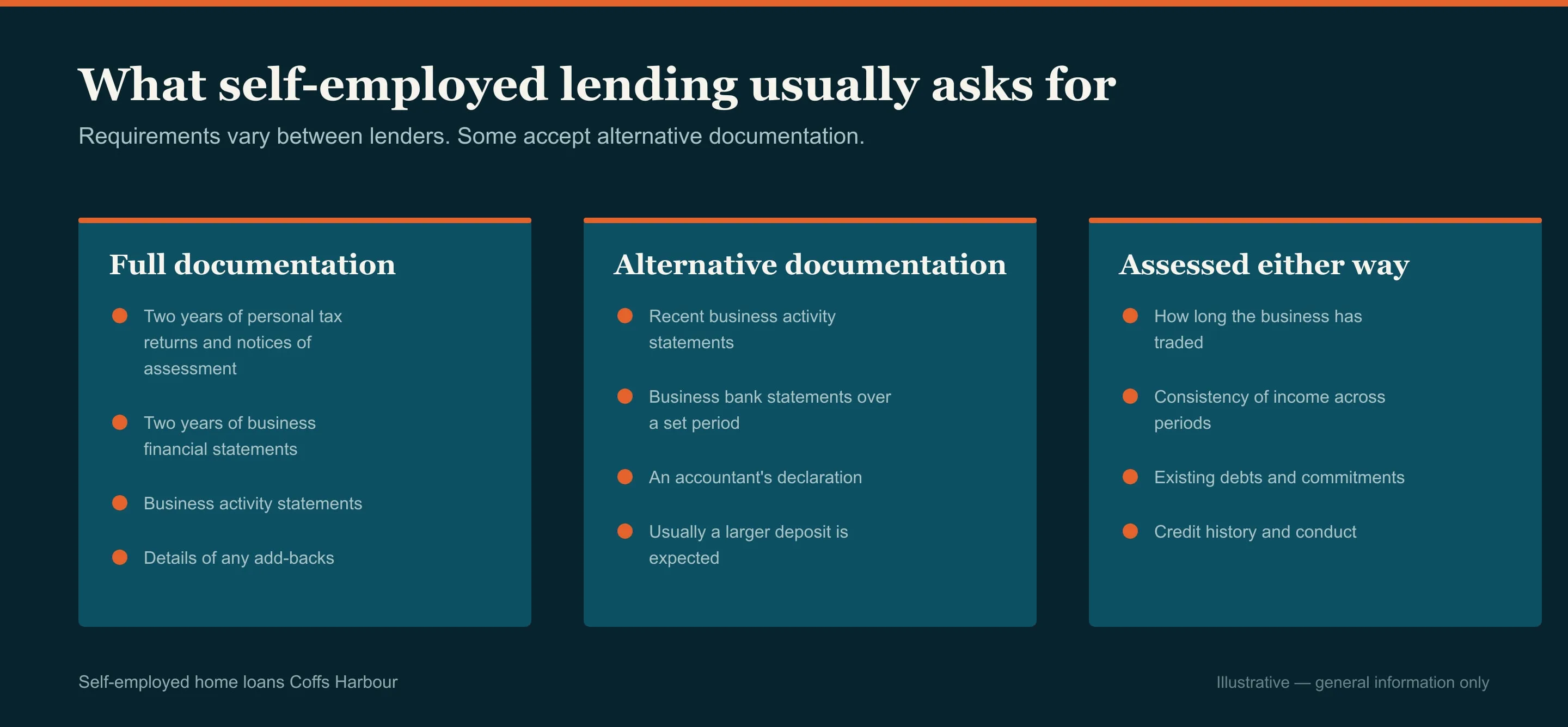
- Two years of personal tax returns and ATO notices of assessment
- Business financials for the same period, profit and loss and balance sheet
- Your last twelve months of BAS if you have them
- Business bank statements, and personal ones kept separate from them
- Your ABN and GST registration dates
First questions
Questions Before You Apply
What do you need from me to get started?
Two years of tax returns and notices of assessment, your business financials for the same period, and your last twelve months of BAS if you have them. It is the same list for every Coffs Harbour lender, so nothing you gather is wasted. If you are missing something we will tell you whether it matters before you go looking for it.
Do you charge me for this?
No. The lender pays us a commission when your loan settles, so the assessment, the packaging and the application cost you nothing. That includes the outcome where we tell you to lodge your next return and come back, which earns us nothing at all.
How long does approval take?
Usually one to two weeks to a decision once the documents are complete, and four to six weeks to settlement. Self-employed files attract more questions from credit assessors, which is why we write the explanations into the application rather than waiting to be asked.
Home Loans For Self-Employed Locals in Coffs Harbour
The paperwork is heavier than it is for a salaried borrower, and that is the whole of the difference for most of the self-employed people we see in Coffs Harbour. Two years of returns, the notices of assessment that go with them, and business financials will get most files assessed on ordinary terms at ordinary rates.
Some lenders will work from one year of returns where the business is established and the industry background is strong. A few will look at under twelve months of trading if you were doing the same work as an employee beforehand. Both are narrow lists, and knowing who is on them is most of the value we add.
Where applications actually fail
- Returns not lodged, or lodged but with tax still owing
- Add-backs claimed that the chosen lender does not allow
- An ABN or GST registration too new for the lender approached
- Business and personal spending run through the same account
None of those is fatal on its own. Each one is much easier to deal with before lodgement than after a decline, which is why we look at all four first.
Full-Doc vs Alt-Doc: Which Path Suits You
Full-doc is the normal path and the cheaper one, and it is the one most Coffs Harbour clients end up on. Alt-doc exists for the case where your returns do not yet show the income the business is genuinely earning, and it costs you in deposit rather than in paperwork.
What alt-doc actually is now
Low-doc in the old sense is gone. You cannot self-certify your income to an Australian lender, and anyone suggesting otherwise is describing a product that no longer exists. What replaced it is alt-doc: your income is still verified, just from different documents.
- Twelve months of BAS, annualised and then discounted by roughly 70% to 80%
- Business bank statements read for consistent trading income
- A declaration from your registered tax agent confirming the figures
The trade is the loan to value ratio. Alt-doc usually caps between 60% and 80% of the property value, so you need a larger deposit, and mortgage insurance may be available above 60% or 70% depending on the lender.
Lodge the return first, or go alt-doc now
If a lodged return would put you into full-doc territory within a few months, waiting is usually the cheaper decision and we will say so. If you are buying now and the deposit is there, alt-doc gets it done. We put both timelines in front of you with the costs attached rather than choosing for you.
What the lender actually assesses
Taxable income, not turnover
What the business banked is not what gets counted. Assessment starts at the taxable figure, then add-backs go on top, and which ones a lender allows varies sharply between them.
Lender income policy, indicative, confirm per lender
What Income The Lender Will Use
The starting point is your taxable income, which for most self-employed people in Coffs Harbour is well below what the business banked. Everything you legitimately claimed to reduce tax also reduces the figure a lender begins from. Add-backs are how some of it comes back.
What can usually be added back
- Depreciation, because it is an accounting entry rather than money spent
- One-off expenses that will not recur, where you can evidence that
- Interest on debts that are being refinanced or repaid
- Retained company profits, with some lenders and not others
That last one moves the answer most for anyone trading through a company. Lenders that count retained profits can assess a materially higher income than lenders that stop at what you paid yourself. Same business, same year, different answer, and it is decided entirely by where the file is lodged.
Where two years are used, most lenders take the lower year or an average rather than the better one. A down year does not end the application, but it needs explaining in the file rather than being left for an assessor to interpret.
Getting Approved When You Work For Yourself in Coffs Harbour
Approval in Coffs Harbour comes down to matching your figures to the lender whose policy reads them most favourably, then presenting them so that no assessor has to guess. Both halves matter, and the second one is where a packaged application beats a branch appointment.
The assessment then adds three percentage points to the rate you would actually pay, a buffer APRA held steady on 27 November 2025, and counts your credit card limits rather than the balances. Cards you never use still reduce what you can borrow, so closing or reducing them before lodgement is often the cheapest improvement available.
What we do about a tight file
Where the numbers are close, the options are usually a different lender, a reduced card limit, a longer term, or waiting for a return. We tell you which one moves your file and by roughly how much, so you are choosing between real options rather than hoping.
We also test the position before anything is lodged. A decline sits on your credit file and makes the next lender more cautious, so the order in which applications are made is worth getting right the first time.
Asked and answered
Self-Employed Loan Questions
Can I get a loan with only one year self-employed?
With some lenders, yes. One full year of returns plus notices of assessment is enough for a reasonable list, particularly where you worked in the same field as an employee beforehand. Under twelve months narrows it much further and usually means alt-doc and a bigger deposit.
What are add-backs?
Expenses subtracted from your taxable income that a lender will add back on, because they are not money leaving the business. Depreciation, one-off costs, interest on debt being refinanced, and with some lenders retained company profits. Which ones are allowed varies sharply, and that variation is often worth more to you than a rate difference.
Do low-doc loans still exist in 2026?
Not in the old form. Self-certifying your income is no longer possible with an Australian lender. What exists now is alt-doc, where the income is still verified but from BAS, business bank statements or an accountant’s declaration instead of full returns. Expect a lower maximum loan to value ratio in exchange.
Why is my assessed income lower than what my business earns?
Because assessment starts at taxable income, not turnover or what the business banked. Every legitimate deduction that reduced your tax also reduced the starting figure. Add-backs recover part of it, and choosing the lender with the most generous add-back policy recovers more.
Will I pay a higher rate because I am self-employed?
Not on a full-doc application. If your returns and financials support the loan, you are priced like any other Coffs Harbour borrower. Alt-doc lending is priced higher and capped at a lower loan to value ratio, which is the real cost of taking that path.
Who you deal with
Who Reads Your Financials
The person who answers is the one who goes through your returns line by line and writes the income summary the assessor reads. Not a call centre, and not someone who will send the same file to whichever lender is on a promotion.
Tourism operators, trades and sole traders make up a large share of the work in Coffs Harbour, so lender income policy is something we deal with weekly rather than look up.
- What it costs to ask
- Nothing. The lender pays a commission when a loan settles, which is where our income comes from.
Where to start
Find Out What Your Figures Will Borrow
Bring your last two returns, or just tell us roughly what you earn and how long you have been trading. We will tell you where you stand with lenders in Coffs Harbour and which path is cheaper for you.