Switching, consolidating, releasing equity
Refinancing Coffs Harbour
Refinancing Coffs Harbour is almost always pitched to you as a rate, and the rate is the part least likely to decide whether the switch is actually worth making.
We read the loan you already have, price what lenders would write for you today, total what moving would cost, and give you the net number. Sometimes that number says stay where you are.
- Your current loan priced against the market
- Every switching cost totalled before you decide
- An honest answer, including when the answer is stay
Have your loan reviewed
Your latest loan statement and a rough value on your place is enough to start.
What We Do, And When We Tell You Not To
We read your current loan in full: the rate, the balance, the term left to run, the fees attached to it and what your lender would charge to discharge it. Then we price the same position across the lenders whose policy fits your income, subtract every cost of moving, and hand you one number. If we switch you, we package the application, chase the discharge and coordinate settlement.
It suits you if you have owned in Coffs Harbour for a few years, have never asked your bank for a discount, and suspect you are paying more than a new customer would. It also suits you if the reason is not the rate at all: consolidating other debts, releasing equity, or getting an offset account your current loan does not have.
It is not worth doing if your loan is already sharp, or if you are inside a fixed term with a break cost that swallows the gain. The review costs you nothing either way, because the incoming lender pays us a commission when a loan settles. Telling you to stay put is the one outcome we are not paid for, and we say it often enough that it is worth knowing up front.
Step by step
How We Run Your Refinance
Five stages. Most refinances settle in four to six weeks, and the slow part is almost always the outgoing lender releasing your mortgage.
-
Statements review
We read your current loan statement and the rate you are on, then tell you whether there is enough in it to be worth going further.
-
Payout and valuation
A few days. We request your payout figure, break cost included if there is one, and order a valuation so you know the loan to value ratio you are working with rather than guessing at it.
-
Lender comparison
We price your position across lenders, your current one included, and show you the saving that survives after every switching cost has come out of it.
-
Application
Typically one to two weeks to approval. We lodge with the lender whose policy fits your income and your debt to income ratio, so the file is not tested twice.
-
Discharge and settlement
Two to four weeks. We chase your outgoing lender for the discharge authority, which is the step that stalls most often, and you hear where it is up to instead of having to ask.
What to have ready
- Your most recent home loan statement, showing the rate and the balance
- Your latest rates notice
- Two recent payslips each, or two years of tax returns if you work for yourself
- Statements for any other loans or cards you are thinking of rolling in
First questions
Questions Before You Switch
Do you charge me for the review?
No. There is no fee for the review, no fee for the application and nothing to pay at settlement. The incoming lender pays the commission, and it is set by the lender rather than varying with which one we put you to, so recommending the cheaper loan costs us nothing. Where the answer is to stay and ask your current bank for a discount, that is the outcome we earn nothing from.
What do you need from me to tell me whether it is worth it?
Your current loan statement and a rough figure for what your home in Coffs Harbour would sell for. Those two are usually enough for a useful answer. Full documents only come into it once you have decided to proceed.
How long does a refinance take?
Refinancing Coffs Harbour usually runs four to six weeks end to end. Approval is commonly one to two weeks once your documents are in, and the rest is your old lender releasing the mortgage, which is the step nobody can hurry and the one we chase hardest.
Is Refinancing Worth It in Coffs Harbour?
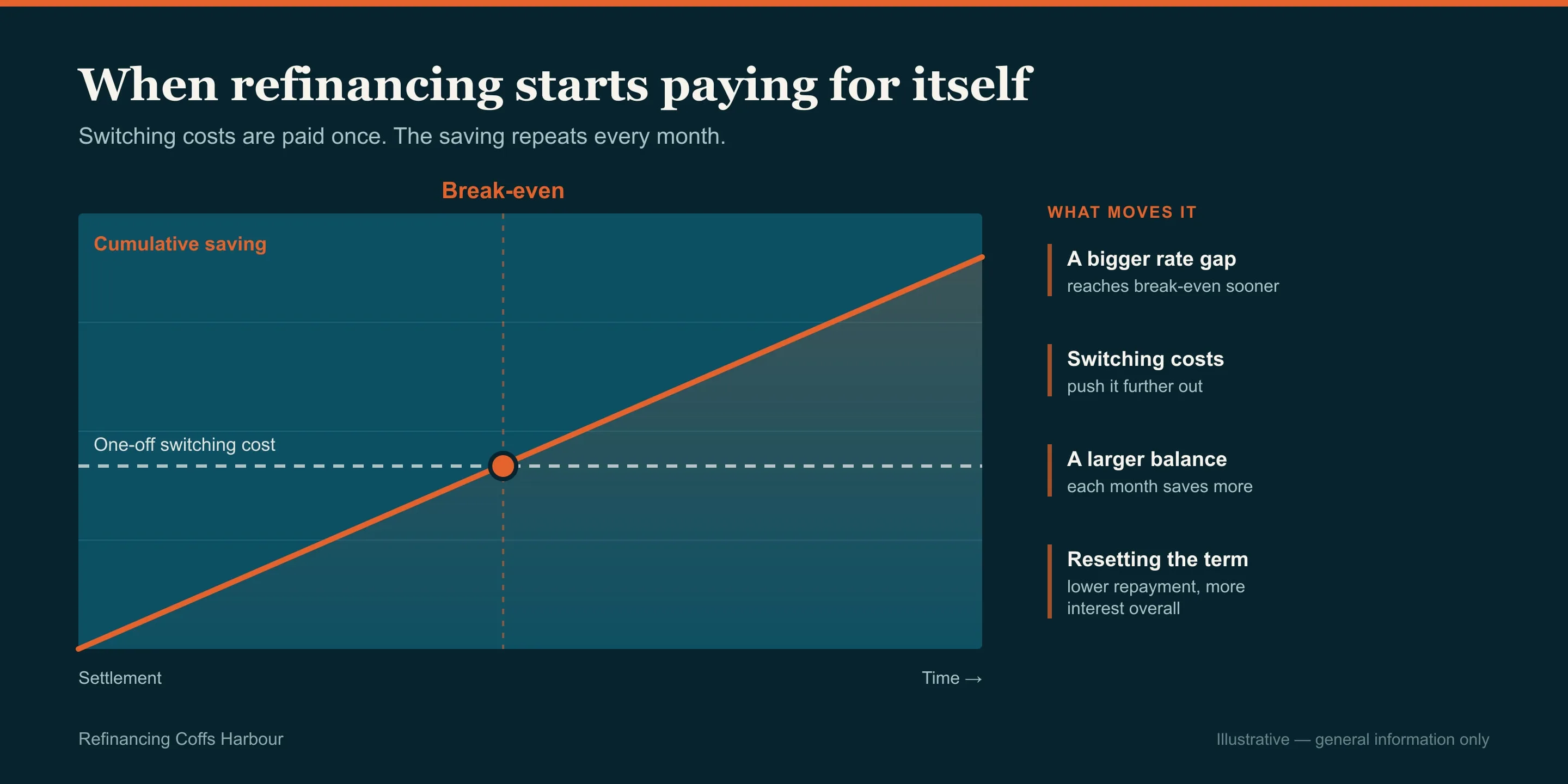
The saving has to survive the switching costs, and on a Coffs Harbour loan the switching costs are the part most comparison articles skip past. We total them against your actual loan before we recommend anything.
- A discharge administration fee from your outgoing lender
- A valuation on your property for the incoming one
- Government registration fees on the discharge and on the new mortgage
- A break cost if you are still inside a fixed term
What a fixed rate break cost turns on
It is not a flat penalty. It is calculated on how much you owe, how long is left on the fixed term, and how wholesale funding rates have moved since you fixed. If rates have risen since you locked in, the cost is often small or nothing at all. If they have fallen, it can be substantial. We ask your lender for the actual figure before you decide, rather than estimating it.
Sometimes staying wins
Your current lender would generally rather reprice your Coffs Harbour loan than lose it, and a repricing costs nothing and takes about a week. We tell you when asking them is the better move. A switch only gets recommended where the saving is still there after every cost above has come out.
What Could Change Your Borrowing Power
A refinance is a new Coffs Harbour application rather than an administrative transfer. Your new lender assesses you from scratch, on today’s rules and today’s income, which is why a loan you comfortably afford can still be declined somewhere else.
The assessment adds three percentage points to the rate you would actually pay, a buffer APRA held steady on 27 November 2025. On a like for like refinance where you are not borrowing a cent more, some lenders will apply a reduced buffer. Not every lender, and not on every loan. Knowing which ones will is a large part of what we do for a borrower whose numbers are tight.
The debt to income limit
On top of that sits a debt to income limit. From February 2026 lenders can write no more than 20% of their new mortgages at six times income or above, and refinances count toward that quota. If your loan sits near six times your income, which lender you approach matters a great deal more than the rate they advertise, and we choose on that basis.
The combination bites harder in Coffs Harbour than in most markets. The ABS 2021 Census put the median weekly household income here at $1,363 against prices closer to metro levels, so serviceability rather than equity is usually what decides whether a refinance is approvable. We test it before anything is lodged, so a decline never lands on your credit file.
The cap on high debt-to-income loans
20% of new lending
Lenders can write no more than this share of their new mortgages at six times income or above. Refinances count toward it, so a top-up that was straightforward last year can be tight now.
APRA, in effect from February 2026
Consolidating Debt Into Your Home Loan
Rolling a car loan or a card balance into your Coffs Harbour mortgage cuts the interest rate on that debt and drops your total monthly outgoings. It also stretches a four year debt across twenty five years, and that is where consolidation quietly costs more than it saves.
So we model it both ways for you: total interest if you consolidate and hold the same repayment, and total interest if you consolidate and drop to the new minimum. The first usually wins comfortably. The second often loses.
Consolidate, or keep them separate
Consolidation makes sense where the cash flow relief is genuinely needed, or where you will hold the higher repayment voluntarily. It makes less sense where the debt is nearly paid off, or where the pattern is likely to repeat and the cards simply refill.
Where we do consolidate, we usually recommend closing the accounts rather than reducing them, and we set that up as part of the application. A card left open behind a consolidation is counted against you at its full limit the next time you borrow.
Releasing Equity From Your Coffs Harbour Home
If your home is worth more than when you bought it, a refinance can pull some of that value out as cash. Lenders call it cash out, and they will want to know exactly what it is for.
Renovations, a deposit on another Coffs Harbour property, or an investment purchase are all ordinary and approvable. A vague answer is not. Above a modest amount you should expect to supply evidence: a builder’s quote, a contract, a statement of intent. We tell you what your lender will want before we lodge, so the request is not knocked back for the want of a document.
Release equity, or protect your loan to value ratio
Pulling equity out raises your loan against the same Coffs Harbour property. Cross above 80% of the value and mortgage insurance is triggered again, even though you paid it the first time, because it does not carry across. We calculate exactly how much you can take before that fires, and show you what taking more would cost.
The other consequence is the debt to income test above. A top up increases your debt without touching your income, so a cash out refinance is more likely to run into that cap than a straight switch. Both get checked before you decide how much to release.
Asked and answered
Refinancing Questions
How much could I actually save?
It depends on your current rate, your balance and how long is left on the term. We calculate the saving net of the discharge fee, the valuation, the registration fees and any break cost, and give you a single figure. Where that figure does not justify the switch, we say so.
What does it cost me to refinance?
Refinancing Coffs Harbour property carries four costs: a discharge administration fee from your current lender, government registration fees, usually a valuation, and a break cost if you are inside a fixed term. Many lenders absorb some of them to win your loan. We total what is left against your own file before you decide.
Can I refinance while I am on a fixed rate?
Yes, though there is likely to be a break cost. It is calculated on your balance, the time left in the fixed term and how funding rates have moved since you fixed, rather than being a flat fee. We ask your lender for the real number before you commit either way.
What happens if the valuation comes in low?
A low valuation lifts your loan to value ratio, and above 80% it triggers mortgage insurance you have already paid once. Sometimes the answer is a different lender, because valuation panels differ. Sometimes it is to leave the loan where it is. We find that out before an application is lodged rather than after.
Will refinancing hurt my credit score?
A lodged application leaves an enquiry on your file, and several of them in a short window reads badly to lenders. That is precisely why we check your position against lender policy first and lodge once, where we expect the answer to be yes.
Who you deal with
Who Handles Your Switch
The same broker reads your statement, prices the alternatives and rings your old lender for the discharge. Nobody hands your file on halfway through, which matters most in the fortnight where the outgoing bank goes quiet.
We are based in Coffs Harbour and take most of this by phone and email, because a loan statement and a conversation is genuinely all it takes to get started. Come in and sit down if you would rather.
- What it costs to ask
- Nothing. The review is free, and we are only paid if you switch and the loan settles.
Where to start
Find Out Whether Switching Is Worth It
One statement and a rough value on your Coffs Harbour home is enough for a real answer, and the answer is sometimes that the loan you have is fine.